
Grant County Court Docket Basics
A docket is the court's running event list for a case. In Grant County, docket information belongs to Grant County District Court because Minnesota uses a unified District Court system for civil, family, probate, juvenile, criminal, traffic, and conciliation matters. The docket may show hearing dates, filings, orders, notices, appearances, dispositions, judgment events, and other register-of-actions entries. It helps a reader track what has happened and what is scheduled next, but it does not always provide every filed document.
Grant County does not have a separate municipal court, justice court, county court at law, or stand-alone probate court in the official court structure. The same District Court, within the Eighth Judicial District, handles the docket for traffic citations, criminal appearances, probate hearings, family matters, money judgments, and civil case activity. A docket entry can be public even when the document behind it is not remotely available. For legal-use copies, the local Court Administrator remains the source for certified documents.
The official court structure is described by the Minnesota Judicial Branch Grant County District Court page, which identifies the court's broad original jurisdiction. That unified structure is why docket searches should be filtered to Grant County rather than to a city court or township court. The absence of a local lower-court layer also means warrant, traffic, and probate hearing events often route back to one courthouse record system.
Find Grant County Court Dockets Online
The main online channel is Minnesota Court Records Online, or MCRO. The MCRO overview explains that the public tools include Case Search, Document Search, Hearing Search, and Judgment Search. For docket timing, Hearing Search is often the cleanest starting point because it is built for scheduled hearings. Case Search is useful when the case number is known or when the user needs the broader register of actions.
- Open MCRO Hearing Search for hearing dates, or use Case Search for full case activity.
- Choose the name, case number, judicial officer, or attorney tab that fits the information already known.
- Set the court location to Grant County when the tool allows a county filter, especially for common names.
- Review the hearing type, hearing location, connection type, judicial officer, date, time, party name, and case number.
- Call Court Administration before treating an omitted calendar entry as a cancelled hearing.
The Grant County daily calendar PDF is a separate practical source for hearing-day information. It can be searched as a PDF and may show probate, criminal, traffic, civil, or family hearings scheduled for a public courtroom calendar. Calendar entries are useful for attendance planning, but MCRO terms warn that public data may be missing online when Rule 8 or confidentiality limits apply.
MCRO Hearing Search is shown in the captured Grant County research as the core hearing tool.
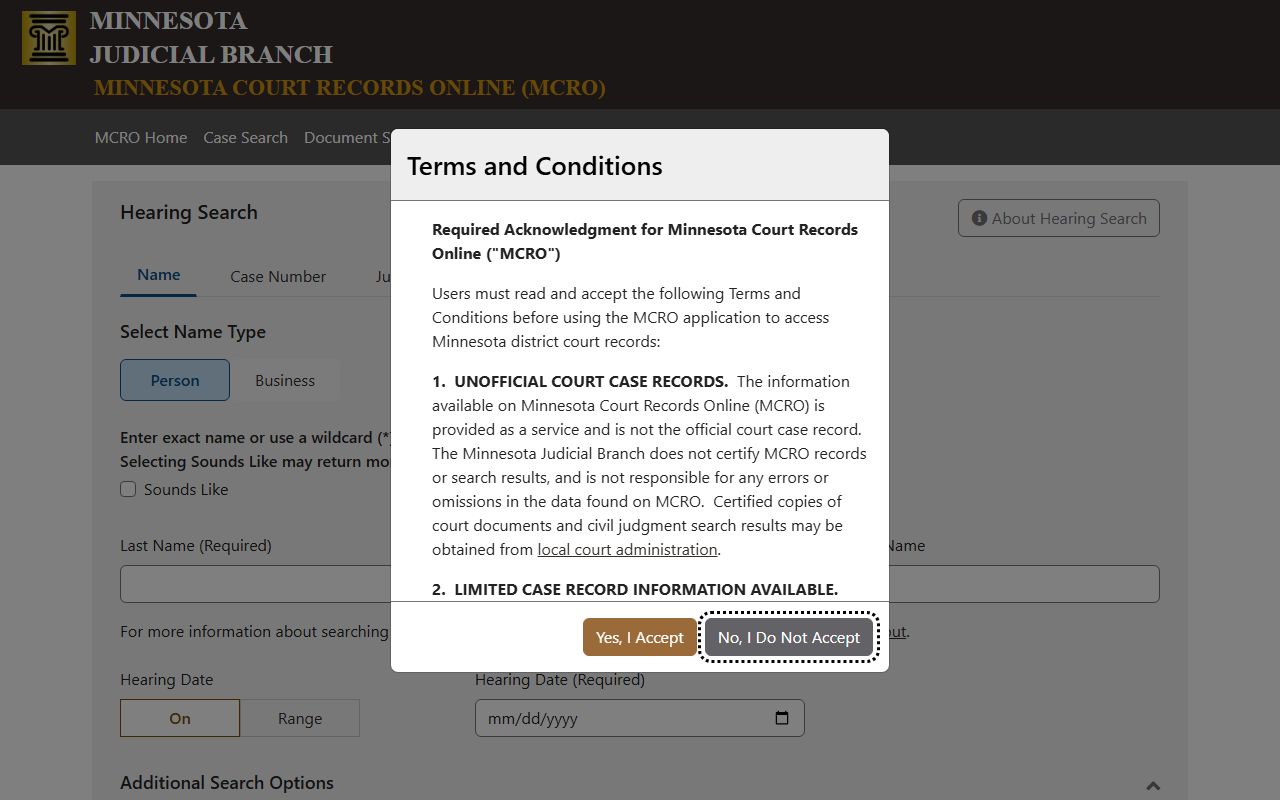
The hearing search image reinforces that Grant County court dockets are found through statewide controls, then narrowed by county, case, person, judicial officer, or attorney.
Grant County Docket Entry Fields
The daily calendar and MCRO hearing tools expose the fields a public user normally needs before going to court or checking case status. The public calendar examples in the research included probate case numbers such as 26-PR-26-80 and 26-PR-26-81, where PR indicated probate. The research also warns against over-reading the code, since the visible calendar is a scheduling tool rather than a full case-number manual.
| Field | What It Shows |
|---|---|
| Party Name | The party connected to the listed hearing, when public and remotely shown. |
| Hearing Location | The courtroom, courthouse, or hearing location information posted for the event. |
| Hearing Date Time | The scheduled date and time for the public hearing entry. |
| Judicial Officer | The judge or officer assigned to the listed event. |
| Hearing Type | The event label, such as a probate hearing or other case-specific hearing. |
| Connection Type | Whether the event is listed with an in-person, remote, or other connection format when posted. |
| Case Number | The court file number used to connect the hearing to MCRO case details and Court Administration records. |
For full case context, match the docket entry to the case details and register of actions in MCRO. A hearing entry may tell when a matter is set, while the register of actions may show filed motions, orders, notices, dispositions, and financial entries. Certified docket or order copies must be requested from Grant County Court Administration.
Grant County Courts With Dockets
Official research found one local trial court level for Grant County case dockets: District Court. That matters because a user does not need to sort between city dockets, justice court calendars, and county court calendars. The relevant question is which District Court case type applies and whether that case type is remotely accessible.
- Grant County District Court: civil, family, probate, juvenile, criminal, traffic, and conciliation docket activity.
- Probate Division of District Court: probate hearing activity within the same District Court case system.
- Minnesota Court of Appeals: appellate docket activity after an appeal from District Court, handled outside the county trial calendar.
MCRO Judgment Search is a related docket tool for docketed money judgments and satisfactions.
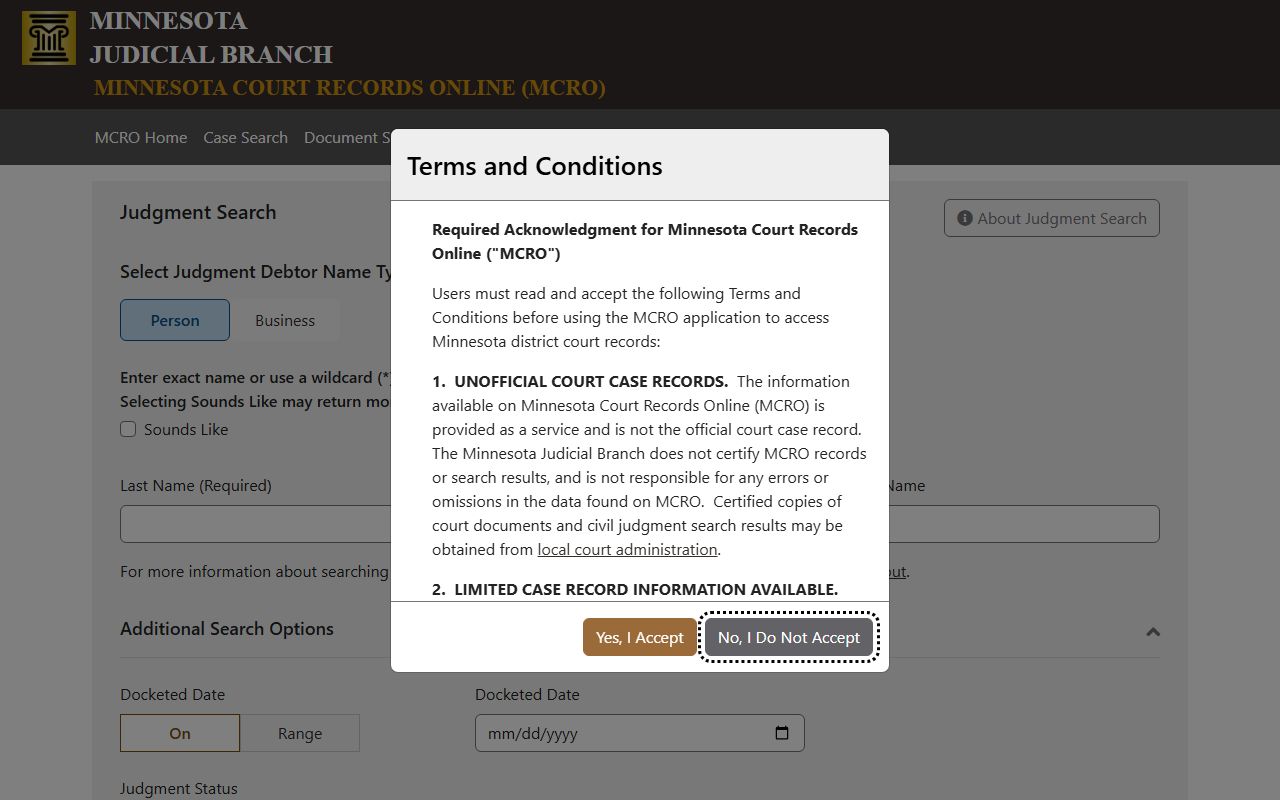
Judgment Search is not a hearing calendar, but it helps separate money-judgment docket information from the broader District Court case calendar.
Grant County Dockets vs Case Records
A Grant County court docket is best read as the index and timeline for a case. A full case record may include pleadings, criminal complaints, motions, affidavits, orders, judgments, sentencing entries, exhibits, and public documents available online under Rule 8. The docket can identify that an order was filed, but the order itself may require Document Search, Case Search document access, courthouse terminal review, or a Court Administration copy request.
| Docket | Full Case Record | |
|---|---|---|
| Format | Event list, calendar line, or register-of-actions entry. | Documents, orders, judgments, sentence details, and exhibits where public. |
| Access | Often visible through MCRO or the daily calendar when public. | Some documents are online, some are courthouse-only, and certified copies come from Court Administration. |
| Use | Track hearing dates, event history, and next steps. | Review filed allegations, orders, dispositions, sentencing terms, or judgment language. |
| Limit | Does not prove every document is public online. | May contain restricted, sealed, or redacted material not available remotely. |
MCRO also warns that pending criminal, traffic, and petty misdemeanor cases with no conviction may not return by defendant-name search. In those situations, a case number, citation number, or direct contact with Court Administration may be more reliable than a name-only docket search. The full Grant County court records path explains those case-search limits in more detail.
Read Grant County Court Dockets
Start with the case number, party name, and hearing type. Then compare the event date to the current calendar. A probate hearing entry means something different from a criminal first appearance, and a traffic citation event may be tied to a citation number rather than a full complaint. If the docket shows disposition, sentence, satisfaction, or judgment language, read the surrounding register entries before drawing a conclusion about outcome.
- Register of Actions
- The court's event log for filings, hearings, orders, judgments, notices, and dispositions.
- Disposition
- The current or final outcome of a case or charge, such as dismissed, convicted, paid, closed, or otherwise resolved.
- Continuance
- A postponed hearing or deadline, often followed by a new date.
- Satisfaction
- A filing that shows a money judgment has been paid or resolved.
Restricted case types can affect what appears. MCRO terms say Domestic Abuse/OFP and Harassment Restraining Order case types are not available on the internet, child-protection and certain juvenile delinquency records are excluded from MCRO, and civil commitment public documents are not available remotely. Calendar omissions can reflect those limits rather than an error.
Note: A missing online hearing should be checked with Court Administration before anyone skips court or assumes a date changed.